


Ensuring accountability for the Global Refugee Compact pledges on education
We are at the start of a learning process that must be open, responsive, and committed, and which must have at its core the education rights and needs of every refugee child and youth
 We are a few weeks away from the first Global Refugee Forum, to be held in Geneva 16th-18th December. The Forum marks the first year since the Global Compact on Refugees was signed. The Global Compact, the result of a long and consultative process influenced by INEE and many of its members, includes a clear focus on education for refugees. Through it, states have committed to “enhance the quality and inclusiveness of national education systems to facilitate access by refugee and host community children” and to mobilize support to “minimize the time refugee boys and girls spend out of education” so that no refugee child or youth spend more than a maximum of three months out of education.
The Global Compact commits States and other relevant stakeholders to more direct financial and technical support to expand educational facilities and teaching capacities to meet the specific needs of refugees, such as the need for safe learning environments and psycho-social support, and the specific needs of marginalized groups such as girls and children with disabilities. This should be achieved through the inclusion of refugees in national education sector plans, remote learning, flexible learning programmes, and the recognition of qualifications and certifications across borders.
All of which builds on the international legal frameworks in the 1951 Refugee Convention’s Article 22 on education and the parallel Article 22 on refugee children in the Convention on the Rights of the Child (see INEE’s new blog on the importance of this convention).
We know, however, that significant barriers must be overcome if the goals of the Global Compact are to be realized. Globally, 3.7 million refugee children are out of school, denied their right to education. More than a quarter of primary aged refugee children have no access to education, and for older children and youth, the situation is even worse: 76% of refugees do not have access to secondary school and only 3% of refugees have access to higher education. (Source: UNHCR) For every ten refugee boys in secondary school, there are fewer than seven girls. (Source: UNHCR)
For a fuller picture of the state of education for children and youth in crisis and conflict, please have a look at INEE’s 2019 Advocacy Briefs (in five languages) on why immediate and targeted action is needed for children and young people living in vulnerable situations, including forced displacement, in order to reach the Sustainable Development Goals by 2030. Governments, donors, international organisations, and practitioners, including INEE itself, must dedicate their policies, funding, and programmes to evidence-based solutions that can enable all refugee girls and boys to access their right to a quality education. And we must as a community be ambitious, meet high standards of accountability, and measure and report on our progress.
A global framework for refugee education
The Global Refugee Forum is designed to build momentum for the achievement of the Global Compact, to highlight the needs of refugees and mobilize concrete action. The Forum itself will address a number of core themes, with a high level discussion on education, spotlight sessions on education, market place displays, and the sharing of good practice. It will give a voice to refugees, including adolescents and youth who will share their experiences of being displaced and their demand for quality education for themselves and others.
To avoid the Forum becoming just another talking-shop with loose promises and empty words, governments, donors, and all interested stakeholders are called on to make formalized pledges. These pledges represent concrete commitments; they can be financial, policy, advocacy, and/or technical. The Forum will be repeated every four years to assess how far we have come on our pledges, in the area of education and the many other sectors covered by the Global Compact.
The test is if these pledges are enough to keep us on track and accountable for collectively implementing the Global Compact.
INEE, as a network comprised of many different stakeholders, is actively engaging in the Forum and we are pledging our network to strengthen global collaboration and action to promote increased access and completion of safe, free, inclusive, and equitable quality education during forced displacement and crisis. INEE will also play a broader role, assisting and encouraging others to pledge, while simultaneously holding governments, donors, and other stakeholders to account to ensure that there is action behind the words, that pledges materialize in concrete and measurable funding and technical assistance.
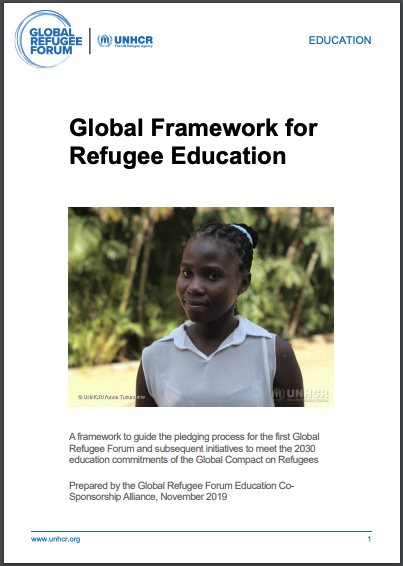 To guide the development of pledges, the Education Co-sponsorship Alliance (over 60 Member States and organisations, including INEE) has this week published the Global Framework on Refugee Education, which sets out the context and call to action in key areas for refugee learners.
This framework covers a number of major themes: inclusion in national education systems; qualifications and skills for work; and emergency response; as well as four cross-cutting headings (policy & planning, financing & resources, equity & inclusion, innovation & connected learning). Each of these themes lists potential pledging areas for stakeholders’ consideration. This document is the result of a lengthy process involving task teams, consultations, and meetings. INEE actively fed into the development of the framework as a whole and co-led on the theme of emergency response.
To be useful both in the lead up to the Forum and beyond, this framework document must be seen as dynamic and not static. It should be used as a tool to help us not just make commitments but to think critically about what it will take to achieve these commitments, with whom, and how. Perhaps also to make us reflect on areas where we may be failing, to enable us to continuously improve, to promote transparency, accountability, and, ultimately, the best education for refugees and host communities.
Our role is to hold ourselves and each other to account - how do we do that?
![[Webinar] From local to global: advocacy for refugee education](/sites/default/files/inline-images/INEE%20advocacy%20for%20refugee%20ed%20webinar%20image.png)
In the coming weeks leading up to and during the Global Refugee Forum, as well as in the months and years to follow, countries and organisations need to step up and make good on their pledges. Our role, as members of INEE, is to help ensure that the right accountability mechanisms are in place. This last part is not yet clear from the framework document. Everyone agrees that the pledges must be realistic and measurable, not empty commitments that will wither before the ink is dry, but do we have the mechanisms in place to ensure this? INEE therefore calls upon UNHCR and the delegates in Geneva in December, as well as every government and organization concerned, to hold themselves and each other to account and to make sure that a solid and contextualized framework of transparent reporting and monitoring is in place.
INEE itself is putting forward a composite pledge from INEE’s working groups, collaboratives, and other main network spaces, in which we commit ourselves to deliver on our core mandate and strategic priorities (read the full text of our pledge below).
In addition, INEE also co-sponsors two joint pledges. The first of these focuses on updating INEE’s most significant contribution to the field of education in emergencies, the INEE Minimum Standards for Education: Preparedness, Response and Recovery. INEE has pledged to “provide updated guidance for humanitarian and development actors, including Ministries of Education, on the Minimum Standards required to ensure safe, inclusive, equitable, and quality education and learning in crisis contexts.” In the other co-sponsored pledge, INEE, together with the Global Education Cluster and UNHCR, commits itself to promoting better coordination in emergency education response.
Like every government, donors, international organization, and other pledging entity, INEE now needs to deliver on these pledges, on behalf of our 16,000 strong membership, and for refugee children and youth everywhere. We count on you to help us see this through!
For more information on the Global Refugee Forum and how to pledge, please visit INEE’s page on the Global Refugee Forum or visit UNHCR’s website.
*************************************
|
INEE Pledge for the Global Refugee Forum 2019 The Inter-agency Network for Education in Emergencies (INEE) will strengthen global collaboration and action to promote increased access and completion of safe, free, inclusive, and equitable quality education during forced displacement and crisis. Through targeted and sustained actions in the areas of advocacy, policy, capacity building, and knowledge management, INEE will support the fulfilment of the right to education for forcibly displaced persons contributing to the achievement of the Global Compact on Refugees, as well as SDG4 and Refugee Education 2030. Focus on the most marginalised girls and boys and youth will inform all actions. By 2023, INEE will bring positive change in funding, programming and policy through dialogue, convening, communication, thought leadership and advocacy across the network to enable the right to free, quality, safe, inclusive, gender-responsive education for all forcibly displaced and host community children and youth. Specifically, INEE will:
|