


Assessing Holistic Learning Outcomes: New Tools in the INEE Measurement Library
About the INEE Measurement Library
The Measurement Library (ML) is a collection of measurement tools for assessing children’s holistic learning and development in low-resource and crisis contexts. The tools target supporting education researchers and practitioners to generate high-quality data and evidence to inform program planning and development. As a one-stop open-access inventory of contextually validated measures, the ML aims to improve the accuracy and timely measurement and assessment of learning outcomes in the Education in Emergencies (EiE) sector.
Since its inception in 2019, the ML has continued to expand gradually and has cumulatively published 31 peer-reviewed measures across different EiE contexts. There remains a critical need for more accessible measurement tools that have been tested with data in the global EiE sector. INEE is pleased to highlight the following new tools that have recently been added to the library:
The Teacher Classroom Observation (TCO) Measure
Authors: Autumn Brown and Jeongmin Lee
Publisher: International Rescue Committee (IRC)
The overwhelming majority of education in emergency interventions aiming to improve children’s learning outcomes leverage teachers through investments in teacher training and support. Yet, despite these investments and the central role teachers play, few gather high-quality data on classroom practices. Why? Because accurately measuring the quality of teacher practice is extremely challenging—even in high-resourced environments. Throw in short project cycles and tight budgets typical of emergency responses, and the task becomes nearly impossible.
In 2016, the International Rescue Committee (IRC) education team set out to develop a rigorous method to measure classroom quality and teacher practices quickly and with limited resources. We analyzed the many observation tools already in use across IRC programs and merged the best parts into one streamlined instrument that aligned with our Teaching in a Healing Classroom curriculum—and the Teacher Classroom Observation (TCO) tool was born.
As we began rolling out the TCO, the early feedback was clear: classroom observations were confusing, overly technical, and just too much. We knew that the training materials were just as important as the instrument itself and we brought in a user-centered designer to refine our approach to make the process easy and accessible.
The result? A revamped training that was both engaging and short. We introduced videos for raters to watch and score together, allowing us to check inter-rater reliability in real-time. We also added interactive activities to help participants quickly get comfortable with the tool’s items, while educating them on cognitive biases and the importance of impartiality during observations.
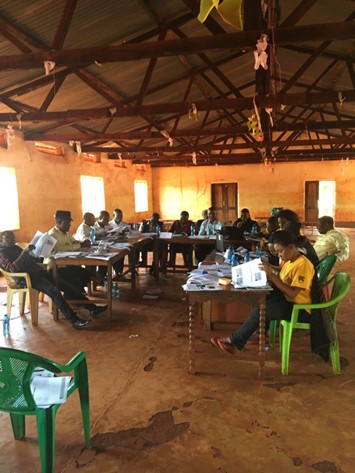
The final product? A concise 2.5-day training and a 22-item observation tool focused on four key constructs: Time on Task, Teaching Practice, Classroom Management, and Emotional Support.
After two years of trial and error across different continents, it was time to put our materials to the test. In Tanzania’s Nyarugusu refugee camp, we trained nine enumerators—all refugees from the camp—and selected six top performers based on their accuracy in practice ratings. These raters then observed 150 randomly selected teachers, working in pairs to ensure consistent scoring and to calculate inter-rater reliability.
The results were promising. The Teacher Classroom Observation (TCO) tool showed high levels of inter-rater reliability, composite reliability, and construct validity across three of the four key constructs: Teaching Practices, Classroom Management, and Emotional Support. Two items—“Connecting to Students’ Lives” and “Use of Classroom Space”—didn’t perform as expected and were removed from the final instrument.
What does this mean? The TCO, combined with its streamlined training materials, offers a quick, reliable way to measure teaching quality in low-resource, fragile environments. While it’s an excellent tool for monitoring and evaluation, researchers planning to use it for more rigorous studies should replicate the psychometric testing to ensure its validity in new contexts.
Even if the items of the TCO do not match your interventions’ needs, we encourage practitioners and researchers to take and adapt our training methods and materials.
For a deeper dive into the development process and the psychometric properties of the TCO, check out the full details [here].
The Social and Emotional Competency Assessment (SECA) Measure
Author: Alison Joyner
Publisher: University College London, Institute of Education
The Social and Emotional Competency Assessment (SECA) was developed by teachers, for teachers. It responds to the need for teacher-led assessment of children’s social and emotional learning in real-time, to support holistic, learner-centered teaching and learning. The tool provides five questions for measuring each of four competencies of the Kenya Competency Based Curriculum (KCBC): Self-efficacy, Communication and collaboration, Critical thinking and problem-solving, and Learning to learn.
In a small rural primary school on the Coast of Kenya - with electricity but no wifi, limited classroom space, and insufficient desks and books - three teachers grappling with the demands of teaching the KCBC worked together in an action research process. Over three months they tried out activities to help build social and emotional skills in their learners. They recorded their delight, for example, at seeing how collaboration and communication were generated through a mathematics project to create a map of the village in the sandy soil of the schoolyard. They were inspired by their discovery of how stimulating learners’ curiosity is at the heart of critical thinking and problem-solving.
Using the tool to measure this learning confirmed teachers’ observations. Assessment of 187 individual learners (47% of them girls) in grades 1-3 showed significant progress in learners’ demonstration of behaviors that build the competencies - between 14 and 25% across the four competencies. Significant correlations between the scores on individual competencies showed the interconnection between them - if one competency develops, so will others. This means that teachers can focus on one competency at a time but still improve overall skills. Perhaps most importantly for parents and governments, the findings showed that strong social and emotional competencies support better results in reading and mathematics. There were significant correlations between Grade 3 pupils’ reading and mathematics results and their scores on Self-efficacy, Communication and collaboration, and Critical thinking and problem-solving.
The SECA adapts the Social and Emotional Competency Parent and Teacher Rating Scale developed in Mtwara, Tanzania by RTI International. It responds to the recommendation of the developers of the tool for further investigation of the social and emotional competencies that help children succeed in school in subsistence-agricultural communities. Given the growing number of competency-based curricula worldwide, the relevance of the SECA tool extends beyond the specific context. It is an important addition to the toolbox of formative assessment tools that teachers need to help them design and adapt their teaching to meet the social and emotional needs and skills of all learners, and so support their overall learning. It holds the potential to be integrated into teacher professional development in Kenya and beyond. Concise and easy to use, the tool could easily be digitalized to facilitate teachers’ data collection and interpretation of results.
In next steps, the tool needs further use and analysis with bigger samples. Please get in touch ([email protected]) if you would like to contribute to wider contextualization and use of this tool, which contributes a small piece to the puzzle of achieving inclusive quality learning everywhere.
The Four Scales Measuring Teacher Wellbeing (TWB) Measure
Authors: Idalia Rodriguez Morales, Jorge Mahecha, and Silvia Diazgranados Ferrans
Publisher: International Rescue Committee (IRC)
Teachers are the most important school factor contributing to students’ learning, well-being, and development. Understanding teacher well-being (TWB) is critical to ensuring high-quality education delivery. However, very few, if any, scales are available for assessing teachers' well-being. This need is particularly important in emergency contexts, where teachers are subject to particular emotional, resource, and logistical challenges. The IRC collected the data used in this study in April and May 2019 as part of a study about a tutoring program for low-performing children in northeast Nigeria. The program was implemented by government school teachers who worked as tutors in an afterschool program in northeast Nigeria.
The scales were developed for teachers in emergency contexts. We conducted a comprehensive review of factors affecting TWB and existing tools for measuring them. This review provided an initial understanding of the array of factors related to TWB, from which country and program teams conducted a joint prioritization exercise and selected self-efficacy, job satisfaction, burnout, and depression as salient and appropriate dimensions of TWB. We also included three additional scales: coaching experience, social support, and collaboration, and teaching barriers to check for concurrent validity.
The purpose of this study was to assess the psychometric properties and evidence of validity and reliability of four different TWB scales in a crisis context. In particular, we aimed to examine whether the scales captured variation in the different aspects of TWB, whether they were reliable, and whether there were data patterns that could be of interest for future data collection exercises. Additionally, we sought evidence of construct, convergent, discriminant, and concurrent validity.
We found evidence of reliability for all four scales measuring aspects of teacher well-being, with Cronbach’s alpha values higher than 0.90. We also found skewed distribution patterns in scale scores that could be interpreted as a tendency in respondents to provide socially desirable answers (i.e., very low stress, very high job satisfaction). Disaggregating responses by region and schools allowed us to identify regions and schools that might require particular support in overcoming challenges to TWB and possible data integrity challenges. We found evidence supporting construct validity for job satisfaction. While self-efficacy, moods, and feelings (depression), and burnout seem to have face validity, CFA model fit indices show that more evidence might be required to make a case for construct validity. The data partially supported our hypotheses on convergent, discriminant, and concurrent validity, attesting to the necessity for more extensive studies to provide empirical evidence to determine the relevancy of considering TWB as a single construct.
Regarding data integrity, teachers should be encouraged to respond candidly. Data collection teams must insist on and clarify the lack of repercussions (negative or positive) of teachers’ responses. As for construct validity, we recommend including more specific items related to the teaching profession and the context of education in emergencies, all in the context of a more extensive sample study.
The Organizational Capacity for Community-based Problem-solving (Org-CapCPS) Measure
Author: Micheal Gumisiriza, Caroline Tubbs, Abiraahmi Shankar, and Evelyn Seminario,
Publisher: Cohere Charity
The Org-CapCPS was developed in response to the growing recognition of power imbalances in global humanitarian contexts, where decision-making and resource allocation often exclude refugee-led organizations (RLOs). Cohere, in partnership with New York University’s Global TIES for Children, created this tool to measure RLO staff’s capacity to address community needs using participatory approaches.
The measure was designed for RLOs in East Africa to evaluate their ability to support community-based problem-solving. Developed collaboratively with RLO staff, the tool incorporates inputs from prior measures such as the Capacity of Community-Based Initiatives Scale and the Community Ownership Scale. This 19-item self-report survey assesses four critical domains: addressing problems, critical thinking, community knowledge, and participation. These domains align with Cohere’s definition of organizational capacity and focus on RLO staff’s ability to engage communities in identifying, analyzing, and solving challenges. The purpose of the Org-CapCPS is to support program monitoring and evaluation, providing RLOs with insights into their organizational strengths and areas needing improvement. It aims to advance equitable and participatory approaches in humanitarian programming.
Key evidence supporting the measure includes its acceptable internal consistency (Cronbach’s alpha ≥ 0.7) and preliminary structural validity demonstrated through confirmatory factor analysis. The hypothesized four-factor structure fit well, although high inter-factor correlations suggest potential for exploring alternative models. This evidence supports the tool’s reliability for assessing organizational capacity in its intended context, while recognizing its pilot-stage limitations.
Next steps involve further testing and validation, including larger sample sizes, iterative refinements, and qualitative feedback. Expanding translation efforts and addressing cultural nuances will enhance accessibility and applicability across diverse settings. Additionally, Cohere plans to integrate the tool into broader sector-wide efforts to promote sustainable, trust-based funding for RLOs and community-driven initiatives.
Conclusion
The four tools are a valuable addition to the education measurement bank for the EiE sector and they underscore the importance of accurate assessment of and commitment to improving learning outcomes for children and youth in crisis settings. The tools in this blog highlight the critical importance of enhancing the capacity of the implementers of education interventions in extremely low-resource contexts. Specifically, the TCO tool evaluates teacher practice and classroom quality while the TWB tool evaluates the impact of tutoring programs in such contexts. The SACA tool evaluates teacher-led assessment of children’s social and emotional learning in real-time, while the Org-CapCPS tool assesses the capacity of refugee-led organizations to engage in and support community problem-solving initiatives, including in education. In sum, these four tools aim to improve the assessment of holistic learning outcomes in the EiE sector. While the evidence on these measures requires further contextualization efforts to improve their validity, they build on the ongoing initiatives of ensuring a timely and more accurate assessment of learning outcomes for children in crisis contexts.
The INEE Measurement Library holds open calls for the submission to be considered for inclusion in the ML every March 1 and September 1. We encourage you to submit!
The views expressed in this blog are the authors' own.