


What do the 10 Principles to Guide EiEPC Financing Approaches look like in practice? Reflections from Save the Children
On 22 September, INEE, alongside the Global Education Cluster, the Global Campaign for Education and international, national and local NGOs, launched a new statement outlining 10 Principles to Guide EiEPC Financing Approaches.
The sector is facing numerous challenges, as well as opportunities for reform, which have been captured in INEE’s Beyond Aid: What's Next for EiE? consultations and blog series. Several bilateral donors are reviewing the multilateral aid architecture for education and their investments in it – aiming to push for greater impact for children but also greater operational efficiency. This is against a backdrop of:
- huge ODA cuts globally - UNICEF analysis shows that international aid to education is projected to fall by US$3.2 billion by 2026 – a 24% drop.
- rising needs - estimates that 6 million more children risk being out of school by end of 2026, 30% of them in humanitarian settings.
Save the Children welcomes the 10 Principles as a common reference point for advocacy on reforms needed to ensure that all international funding for EiEPC is maximised to reach those most marginalised children with quality, safe and inclusive EiEPC support.
What do the 10 Principles mean in practice?
Below are some examples of our innovative work with several funding and implementing partners. We hope they shine a light on progress in the sector aligned to the Principles. As a sector advocating for the implementation of the 10 Principles, we echo INEE’s call for other civil society organisations to also share their work to bring the Principles to life.
EiEPC funding must be fast and adaptive
EiEPC financing must be fast to ensure children are quickly protected in safe spaces with access to life-saving learning. Funding models should also be structured to be adaptive and therefore remain effective in fragile, unpredictable settings, leveraging flexible frameworks and crisis modifiers. In South Sudan, the ECW MYRPII built in a $5 million crisis modifier, the only one of its kind, which unlocked timely funds to respond to several new escalations. This ensured immediate education and child protection support to refugees, returnees and host communities in Renk Country as a result of the ongoing conflict. During the Cyclone Idai response in 2019, ECW coordinated through the Mozambique Education Cluster and was able to disburse First Emergency Response funding within 4 weeks of the cyclone making landfall.
Funding should be coordinated, coherent and catalytic
EiEPC funding must be coordinated to avoid duplication, coherent to ensure alignment of humanitarian and development priorities, and catalytic to maximise scarce resources. In Myanmar, the EiE Sector Group has worked closely with the Ministry of Education and development partners to align emergency education with long-term planning. Through active participation in national education processes and collaboration on GPE programmes, EiEPC priorities were integrated into sector strategies. This led to the appointment of Ministry of Education EiEPC focal points in five crisis-affected states, the introduction of an MoE EiEPC budget line, and the development of a joint emergency preparedness framework, demonstrating how sustained coordination can embed crisis-responsive education within broader system reforms.
Funding should be anticipatory to enable an earlier response
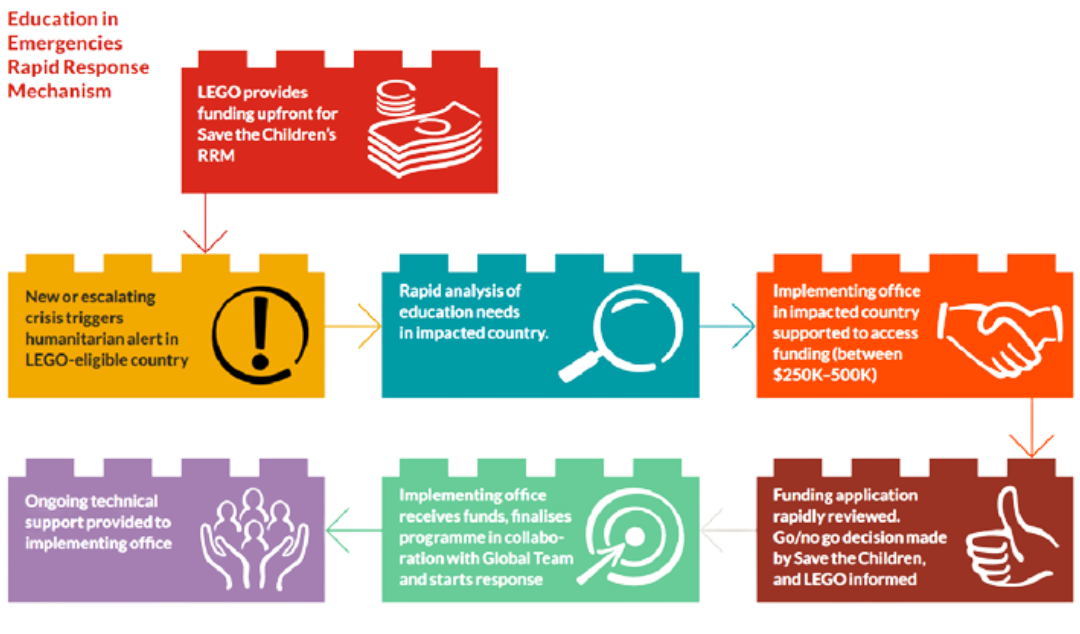
Bilateral and multilateral partners must act early—pre-financing responses and investing in preparedness to keep education going when crises hit. EiEPC funding should help education systems anticipate shocks and minimize disruption. Funding from The LEGO Foundation to Save the Children and the Norwegian Refugee Council through the Rapid Response Mechanism provides funding up-front, which is then allocated immediately a crisis alert is triggered to kick-start play-based learning for children affected by emergencies or surges in protracted crises. 10% of funds are earmarked to support technical and operational preparedness in crisis-prone areas.
ECHO is also supporting school and systems-level preparedness and anticipatory action, building on learning in the Sahel through the ECHO Presue programme, the ECHO ARISE programme in Malawi and Zimbabwe is focused on enhancing national systems and local-level preparedness and developing systems to monitor and trigger anticipatory action and rapid response for both slow and sudden-onset risks.
More funding should directly reach local partners
Investing directly in the capacity of diverse local partners is essential for effective and sustainable EiEPC delivery. Direct funding to national authorities and local NGOs isn’t just a Grand Bargain commitment—it’s cost-effective, reducing overheads and increasing impact.
While ECW is still adapting to enable more direct local funding, progress is being made. In Uganda’s MYRP 2, our partnership with Street Child introduced a Localization Unit—created in response to local partner feedback—to handle compliance and due diligence, easing access to funding. Fully funded by ECW, this model is flexible, cost-efficient, and replicable. As a result, 29% of ECW’s investment to Save the Children flowed through local and national NGOs.
Funding must be accountable to the needs of children and youth
True inclusion means being accountable—not just to taxpayers, but to the communities we serve, especially teachers, children, and youth. Children in crisis consistently rank education as a top priority, yet their voices are often overlooked. To change this, we're partnering with Plan International and NRC on a new study, set to publish later this year. It explores how children’s voices and priorities are—or aren’t—reflected in humanitarian planning and funding, including Humanitarian Needs Overviews, Response Plans, and key funding mechanisms. Using both existing data and new insights from children in crisis, the study aims to explore to what extent the sector is accountable to children and challenge and reshape how decisions are made —making humanitarian responses more accountable, inclusive, and child-focused.
The 10 Principles need to be put into practice
The EiEPC sector is stepping up—with fresh energy, bold intent, and a clear sense of purpose. The 10 Principles lay a strong foundation for real debate, sharper advocacy, and decisive action. One thing is clear: the global needs in EiE are massive and growing. With multiple funding channels—both multilateral and bilateral—ready to make a difference, what matters most is that every dollar aligns with the 10 Principles. That’s how we drive real, lasting impact for children.
Do you have any examples of the 10 principles in practice? We’d love to hear from you! Reach out to [email protected] to share your ideas.
About the Author:
Emma Wagner is Senior Education Policy & Advocacy Adviser at Save the Children. She is co-chair of the Send My Friend to School coalition in the UK. She leads and coordinates Save the Children’s global policy and advocacy work on education in emergencies. She is a member of INEE, GCE and the INGO constituency for Education Cannot Wait