


How Thick Are School Walls? Rethinking Schools in an Age of Polycrises
Even on a street we have never visited before, we can usually tell which building is a school. The yard, the flag, the entrance, the walls. These walls mark the physical boundaries of the school, but they also create a powerful perception: that what is inside can be kept in, and what is outside can be kept out. We tend to believe that when children pass through the school gate, they leave behind the risks, burdens, and uncertainties of their lives.
Yet this belief reflects neither reality nor what should be.
Let us begin with a simple premise: school walls are permeable. What happens outside school constantly enters it, and what happens inside school extends outward into the community. Poverty, care responsibilities, food insecurity, precarious employment, displacement, bullying, and trauma cross the school threshold. So do supportive relationships, safe neighborhoods, and access to public services.
Similarly, what leaves school is not only academic knowledge and skills. Children carry with them ways of relating to others, understanding the world, coping with uncertainty, and recognizing their rights and boundaries. Schools therefore cannot be understood merely as sites of instruction. They are part of a broader social ecosystem that can either strengthen or weaken children’s resilience.
Within this ecosystem, schools are intertwined with policies and institutions beyond education, including health, employment, social protection, and justice. In an era shaped by economic crises, pandemics, climate disasters, and widening inequalities, these interconnections are increasingly visible. Many risks enter children’s lives from outside the school, yet their effects become most apparent within it.
This reality reveals two truths: schools cannot solve these challenges alone, but meaningful responses are also impossible without them.
Resilience Is Not a Trait. It Is a Network.
Resilience is often described as an individual quality: a child is “strong,” “adaptable,” or “persistent.” However, such descriptions obscure a critical point. What we call resilience is not an inherent personal trait but the outcome of relationships, institutional support, and enabling environments.
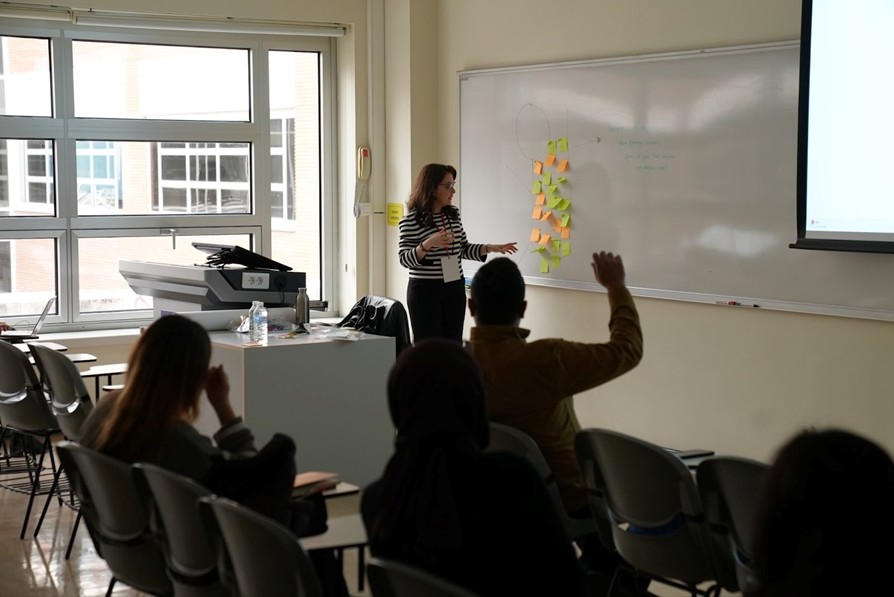
This perspective was central to a workshop held as part of the Good Practices in Education Conference, a biennial gathering in Türkiye where teachers from across the country come together to share innovative and inspiring classroom practices. Organized in collaboration with the Inter-agency Network for Education in Emergencies (INEE), the workshop focused on preparedness and the INEE Minimum Standards.
Together with teachers and civil society participants, we began by drawing a student figure and covering it with sticky notes labeled with characteristics commonly associated with resilience: strong, responsible, adaptable, does not give up. As discussions deepened, participants agreed that these attributes do not emerge in isolation. They are constructed through relationships with teachers and peers, shaped by learning experiences, and sustained by the opportunities and supports that schools, families, and wider systems provide.
Grounded in the INEE Minimum Standards’ emphasis on holistic and system-level approaches, the exercise underscored a central insight: resilience cannot be sustained through individual effort alone. It depends on a network of support that spans classrooms, schools, families, and public policy frameworks.
 Teachers frequently encounter the immediate consequences of socioeconomic hardship in their classrooms. Even when broader systems are insufficient, they strive to respond. They mobilize personal resources, informal networks, and community connections because they see firsthand how unmet needs affect children’s well-being and learning.
Yet when resilience relies primarily on teachers’ individual initiatives and short-term interventions, protective outcomes may emerge for some children, but equity and continuity cannot be guaranteed. Sustainable resilience requires institutional capacity and predictable social policy mechanisms that are school-based, accessible to all, and embedded within the education system.
School meals, school-based social services, and effective referral mechanisms are not supplementary to pedagogy. They are structural components of a school’s capacity to support resilience.
Universal School Meals: A Protective Social Policy Tool
School meal programs are often framed narrowly as nutrition interventions. In reality, they are powerful instruments of social protection.
Free and healthy school meals strengthen children’s connection to school, reduce socioeconomic disparities, and support psychosocial well-being. Access to regular, quality meals increases attendance and improves concentration. It also reduces food-related financial pressure on households. Importantly, the shared experience of eating together fosters belonging and strengthens school attachment.
When school meals are limited to students identified as “in need,” however, protective capacity can be undermined. Targeted approaches may unintentionally label children, increasing stigma and even exposure to bullying. In contrast, universal provision reduces discrimination risks and contributes to a more inclusive school climate.
Particularly in contexts where students travel long distances to centralized schools or where vulnerability is geographically concentrated, universal school meals can offer a practical and equitable starting point for strengthening protective systems.
Where Does Protective Capacity Grow?
Research consistently shows that one of the most powerful protective dimensions of schooling is relational. Trusting teacher–student relationships, supportive peer connections, and a strong sense of belonging enhance both academic and emotional resilience.
When students feel heard, fairly treated, and valued, their attachment to school deepens. At the same time, teachers who feel respected and supported are better able to sustain these relationships. Resilience, in this sense, is reciprocal.
Yet relational capacity depends on structural conditions. Overcrowded classrooms, double-shift schooling, excessive workloads, and limited counseling services weaken the relational fabric that sustains resilience. Policy support at the system level is therefore essential.
During discussions on preparedness for different types of crises, another concept emerged: expanding children’s “crisis repertoire.” The goal is not to keep children in a constant state of alarm. Rather, schools can help them develop the ability to think under uncertainty, seek help, and act collectively. These capacities flourish in environments that prioritize social and emotional learning, cultivate positive school climates, and allow children to express feelings and ask questions in psychologically safe spaces.
Thickening Walls or Strengthening Ties?
In many contexts, growing concerns about school safety lead to an emphasis on physical security measures such as surveillance cameras or stricter controls. While such measures may play a role, research and practitioner experience suggest that children’s sense of safety is shaped most profoundly by relationships.
Fair rules, consistent adults, restorative approaches, and inclusive practices create lasting security. Thickening the walls does not eliminate external risks. Strengthening the protective ties between schools and their surrounding communities, however, can prevent children from disengaging in times of crisis.
A school’s protective capacity becomes sustainable through strong relationships, inclusive institutions, and integrated policies. The question is not only what schools do on their own, but what surrounds and supports them.
If schools are to be truly safe spaces that prepare children for crises rather than simply shielding them from them, they cannot stand alone. When investment shifts from walls to relationships, schools can become not only centers of learning but anchors of child well-being