


Achieving SDG4 for Children and Youth Affected by Crisis
 Note to our readers: We have invited a number of experts and policy makers to comment on this blog piece. New comments will be posted daily. Please scroll down or use the in text links to view the following individual's comments: David Archer, Mary Mendenhall, Vernor Muñoz Villalobos, Zama Neff, Yasmine Sherif, Suzanne Grant Lewis, Manos Antoninis, Lucia Fry, Hani Monsourian, and Gerhard Pulfer.
Attention will be focused on Sustainable Development Goal 4 for education in the coming weeks as the High Level Political Forum opens in New York. But we know that the world will not reach its ambitious 2030 Agenda without ensuring every child and young person in a fragile or crisis context has access to safe quality education. Their education is particularly difficult to achieve and yet especially important. To read more, please see INEE’s new Advocacy brief.
Without significant improvements in education we will not stand a chance of stamping out poverty, eliminating conflict, or addressing the climate crisis. There is an urgent need for governments and the international community to make and adhere to political, financial and legal commitments if we truly are to leave no child behind.
Funding for education in crisis contexts is suffering because education is not seen to be a priority in humanitarian aid, and because development donors do not always see the clear link between development and crisis contexts. Despite the tripling of humanitarian financial assistance in recent years, the share of the total that goes to education has barely risen, standing at a mere 2.3 percent in 2018.
Despite efforts to build a strong foundation that can demonstrate the positive impact of education in emergencies, practitioners and policy makers continue to lack substantial evidence on what works, how, for whom and at what cost. The evidence that does exist has largely failed to translate into coherent, coordinated policy and practice by governments and their partners in terms of how to deliver safe, quality education in emergencies at scale.
As a result, crisis-affected children and youth are disproportionately missing out on their right to education - and the global community is falling behind in its commitment to all children and youth.
 Steps in the right direction
The good news is that the need for more and better funding, and more coherence across humanitarian and development actors, are starting to be addressed more systematically. We have seen this in the work of the first dedicated global fund for education emergencies, Education Cannot Wait. We have seen it in development donors such as the World Bank increasingly investing in education in fragile and conflict-affected contexts. We also see it in the commitment of the European Commission to a significant increase (10 percent) of its budget dedicated to education.
Moreover, the G7 Charlevoix Declaration calls for action to close the gap in access to education for girls and women and for refugees and the internally displaced living both inside and outside of camps, and over 90 countries have joined the Safe Schools Declaration, an inter-governmental commitment to protect education from attack during armed conflict. Yet more funding, and more commitments, do not always translate into meaningful programs that achieve successful learning outcomes for children and youth living in contexts of crisis.
Recommendations
To see meaningful change in the lives and learning of crisis-affected children and youth, we must achieve a catalytic shift in approach and ambition. The Inter-agency Network for Education in Emergencies (INEE) calls on crisis-affected governments, donors and policy makers to devote much greater effort and investment toward the learning of children and youth affected by crises.
Donors and policy makers should:
-
Follow the lead of the European Commission and increase the percentage of humanitarian assistance to education to at least 10 percent of their budgets.
-
Commit to flexible, multi-year funding for education in emergencies to ensure that children in protracted crises can continue their education.
-
Direct funding to education programmes designed to achieve access, and to provide learning (both academic and social-emotional) and safety outcomes for refugees and crisis-affected children, including by supporting the implementation of the Safe Schools Declaration.
-
Operationalise the Grand Bargain commitments and ensure that their humanitarian and development assistance strategies for education are coordinated and coherent, both globally and nationally.
Crisis-affected governments should:
-
Include refugees and crisis-affected learners in their national education sector plans, set targets, and monitor progress toward learning, access and safety outcomes for refugees and crisis-affected learners.
-
Include refugees and crisis-affected learners in voluntary national reviews when reporting on progress toward SDG4, and when reporting on implementation of the Convention on the Rights of the Child and other human rights commitments.
-
Adhere to the Incheon Declaration and increase public spending on education in accordance with the country context, living up to international and regional benchmarks of allocating at least 4-6 percent of gross domestic product and/or at least 15-20 percent of the total public expenditure to education.
-
Endorse and implement the Safe Schools Declaration to protect schools and universities, their students and staff, from being targeted or indiscriminately attacked by armed forces and armed groups.
Areas of particular focus
In addition to such major investments and a focus on systemic needs, INEE has identified some core themes in education that are especially significant and about which INEE’s members have considerable expertise. These include:
Motivating, supporting and paying teachers. During crises, there is often a limited number of qualified teachers. A lack of supervision and support for teachers’ own wellbeing and a lack of sufficient incentives lead to low motivation and high attrition rates for teachers in crisis situations. We recommend among many other things to:
-
Recruit a sufficient, gender-balanced number of qualified teachers, including refugee teachers, who receive decent pay and have reasonable working conditions.
-
Provide sufficient multiyear funding and establish concrete guidelines for effective teacher recruitment and management, relevant, quality professional development, and support for teacher wellbeing.
Providing psycho-social support (PSS) and social-emotional learning (SEL) opportunities. Children affected by conflict and crisis may be suffering from trauma that inhibits their ability to attend and learn in school. Classroom teachers with little knowledge of how to care for the psycho-social needs of such children may find it hard to support them effectively. We recommend among many other things to:
-
Define education outcomes for children that include social-emotional learning and overall wellbeing.
-
Fund programmes that use the best available evidence in design and implementation to achieve these outcomes.
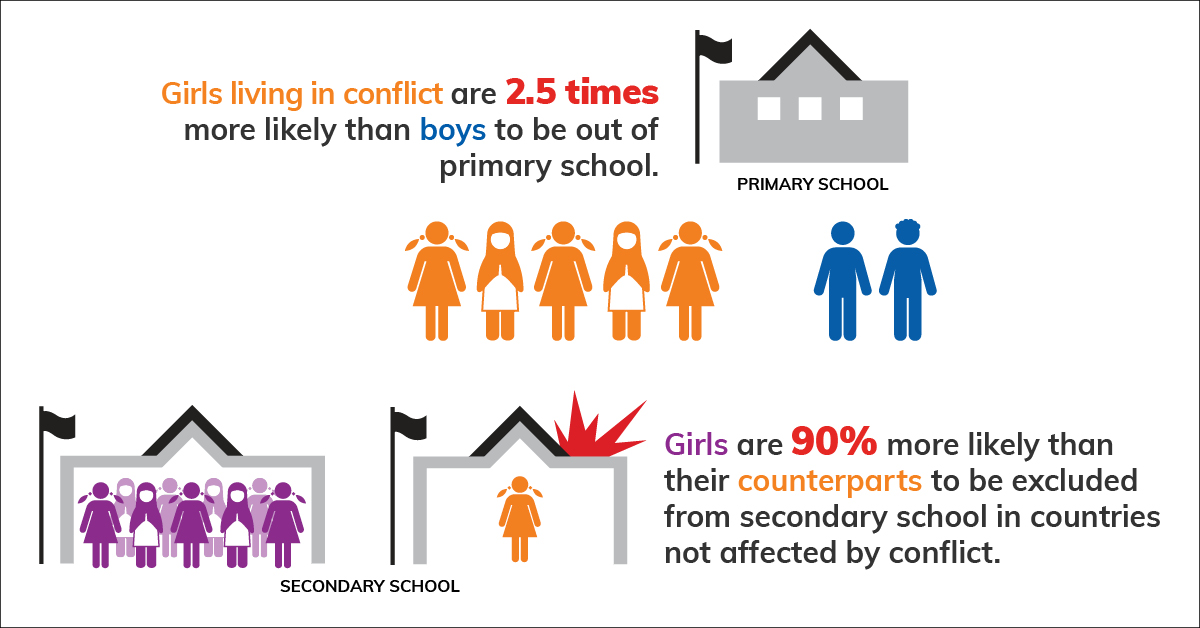 Providing gender-responsive education. During crises, the barriers girls often face in accessing and continuing their education are compounded. Concerns about safety and security, economic pressure and an increase in early marriage have a disproportionate impact on girls’ education. Boys, may be particularly affected by forced recruitment and made to work outside the home. We recommend among many other things to:
-
Adopt gender-responsive policies and programmes on community engagement, financial or in-kind assistance to families, alternative education modalities and targeted strategies to address school-related gender-based violence.
-
Strengthen knowledge management systems to facilitate wide dissemination of proven interventions that address gender and girls’ education in emergencies.
Providing greater protection for education. During emergencies, security may deteriorate dramatically in and around schools, attacks on schools may increase and schools will often be used for military purposes. This puts children at risk of harm, trauma, recruitment or exploitation, all of which are in direct conflict with international humanitarian and human rights laws. We recommend among many other things to:
-
Sign the Safe Schools Declaration and incorporate the Guidelines for Protecting Schools and Universities from Military Use into legislation and military doctrine.
-
Improve efforts to prevent and respond to attacks on education by strengthening the monitoring and reporting of attacks on education, including disaggregating data by type of attack, sex and age of the victims, and type of school.
The issues and recommendations highlighted in these four areas are not the only ones that require attention to achieve SDG4; however, they represent some significant barriers to education which, if not addressed, will doom the attainment of the goal to failure. Together we must work to honour our commitments to children and youth affected by crisis and conflict and ensure that safe, quality education is available for all.
To see our recommendations on the overall and specific themes above, please read the INEE Advocacy Brief for the High-Level Political Forum 2019.
Gerhard Pulfer
Education in Displacement Portfolio Manager; Porticus
"There is little doubt that Education in Emergencies by itself provides structure and protection to children, who find themselves in the midst of war, displacement or natural disaster. Yet, we all harbour doubts about the effectiveness of the rote learning we frequently witness in overcrowded classrooms in the humanitarian contexts and protracted crises around the globe. We thus need to take responsibility for providing meaningful and relevant education in emergencies and particularly in protracted crises, as otherwise we fail these children and dash their hopes for a better life. But can we ensure meaningful and relevant education in EiE contexts? We have evidence on good pedagogy in EiE. We have evidence that social emotional learning (SEL), as well as psycho-social support (PSS) re-establish hope and self-confidence, which are extremely powerful motivators; these approaches also improve classroom dynamics. We have tools for reliable measurement of academic and SEL/PSS. Thus, as funders we have a duty to strive not only for access, but for quality learning where children have access to education. Our responsibility is to trace learning outcomes (academic and SEL) and build on evidence in order to realize SDG 4 for all learners, including those in emergencies and protracted crisis."
Hani Mansourian
Coordinator at the Alliance for Child Protection in Humanitarian Action; UNICEF
(07/16/2019): "Following the dynamic discussions at the 2018 Roundtable hosted by INEE (@INEEtweets) and the Alliance (@CPiE_Global), the interactions between and interdependence of the education and protection sectors, especially in humanitarian action, factor even more prominently in the thinking of field practitioners, policy makers and donors alike. The Alliance commends the efforts of the INEE in promoting quality education programs, especially those that include psycho-social support and social-emotional learning. The Alliance would also like to re-emphasize the importance of both mainstreaming and integrating child protection elements and activities into education in emergency programs. Evidence shows that children suffering from adversity and toxic stress will not do well in school. A child under distress due to separation from her/his loved ones or exposure to abuse and violence will not learn effectively. When the educational environment is not gender sensitive and lacks separate toilets and female teachers, families may be more likely to keep girls at home. Therefore, designing education programs from a child-centered, protection-aware perspective can contribute to child wellbeing and healthy development.
We, in the Child Protection in Humanitarian Action (CPHA) sector, are committed to work actively with our Education in Emergencies (EiE) colleagues to facilitate the achievement of SDG 4, 16 and more, through systematic collaboration across the CPHA and EiE sectors. We will facilitate design and roll out of effective joint and integrated CPHA/EiE programs by documenting best practices; building evidence on effectiveness; fostering innovation; and supporting action. We invite donors and policy maker to bolster these efforts by ensuring that EiE programs have clear indication of how child protection elements have been taken into account and/or integrated."
Lucia Fry
Research and Policy Manager; Malala Fund
(07/12/2019): "This brief from INEE does a thorough job of laying out the political progress to date and remaining challenges on achieving SDG4 in crisis situations. Particularly welcome its focus on improving gender equality in and through education and providing protection to schools. Be great to see INEE highlight examples of national and local organisations - particularly those led by women - in responding to education needs in crisis."
Manos Antoninis
Director of Global Education Monitoring Report; UNESCO
(07/10/2019): "Investing in the education of children and youth affected by crises is a route to achieving more than just SDG 4. When part of multisector humanitarian intervention plans, education can also help achieve other development outcomes. For instance, education programmes should collaborate with shelter, because school-to-house proximity determines access, attendance and learning; with child protection, because planning safe spaces is a prerequisite of safe schooling; and with health, water, sanitation and nutrition, because there are advantages to delivering such services in schools. More generally, schools are important pillars of community infrastructure and catalysts for social progress. Also, schools can play an important role as a haven in times of crisis that signifies a return to normality; as a location where psychosocial support can be provided; but also as a place where social and emotional learning interventions can have lasting effects. Such interventions can help develop skills related to self-awareness, self-management, social awareness, relationship development, and responsible decision-making, which can be negatively affected by the trauma caused by displacement. But social and emotional learning interventions need to be culturally sensitive and adapted to local contexts and perceptions of mental health and well-being needs. And they need to involve communities and parents, taking their values – and also their own traumas – into account."
Suzanne Grant Lewis
Director; UNESCO-IIEP
(07/10/2019): Bravo for INEE’s recommendations in support of governments affected by crisis. IIEP also recommends that crisis-affected governments be supported to more effectively plan and prepare their education systems for crises. Crisis-sensitive planning helps ministries mitigate the negative impacts of crises—including crises that lead to forced displacement—and helps ministries uphold international commitments such as the Sendai Framework. Crisis-sensitive planning entails engaging with governments in utilizing humanitarian and environmental data on the risks countries are confronting. This includes climate change models to map projected changes that may result in internal displacements or emigration. Crisis-sensitive planning challenges us to rethink how education is provided and to plan for educational experiences that will not necessarily be residential. It highlights the need to develop a teaching workforce for a system with more diverse delivery modalities. It is a disgrace that crisis-affected governments face continued scarcity of financing for an increasing number of students with a wider range of needs. Thank you to INEE for highlighting so many key issues.
Yasmine Sherif
Director; Education Cannot Wait
(07/09/2019): Congratulations on this insightful blog! We fully support the analysis and recommendations, and continue to work together with INEE and all our partners to achieve SDG4 for children affected by conflict and crisis. Recalling that attacks against schools, which often result in the killing or maiming of children, are one of the six grave violations against children in armed conflict, it is crucial that prevention is prioritized, including through the physical protection of both schools, children in schools and their teachers. We must also use the monitoring and reporting data collected on such attacks to hold perpetrators accountable and design programmes that cater to their well-being and safety as a premise for learning. Out of school children are at increased risk of sexual and gender-based violence, child trafficking, forced recruitment into armed groups and child labor. This is why - with increased funding support from donors - we must work together urgently with crisis-affected governments, affected populations and relevant partners to take a strong practical protection approach to delivering quality, inclusive and gender-sensitive education for children and youth impacted by crises. Only with physical security and mental well-being can they actually learn and emerge stronger, more resilient and better prepared for life. Together, we must connect interventions essential to learning in a crisis-context and deliver more, because children deserve no less.
Zama Neff
Executive Director of the Children's Rights Division; Human Rights Watch
(07/05/2019): "SDG4 for children affected by crisis needs to include 1) protecting schools, teachers, and students from attack, and 2) insuring that refugee children get a quality education. With the “number of attacks on students, personnel institutions” as one of the indicators of SDG4, it’s exciting that 91 countries have endorsed the Safe Schools Declaration, a political commitment to protect education during war. Most important, many signatory countries are acting. Other countries should endorse the Declaration and implement its provisions to protect schools from attack and military use. For children driven from their homes, the denial of education—including the appalling lack of education for Rohingya refugee children in Bangladesh and many Syrian refugees—can be blamed not just on deeply inadequate resources, but also on policy decisions by host governments that the international community should confront and address. The Global Refugee Compact’s aspirations of providing schooling “a maximum of three months after arrival,” integration in national education systems, and “access to . . . primary, secondary and tertiary education,” including for girls, should be a reality for refugee children."
David Archer
Head of Participation and Public Services; ActionAid International
(07/04/2019): This INEE blog raises important issues around increasing financing for education in emergencies and I support the areas of focus that are suggested, particularly the focus on gender-responsiveness. I think it is important to highlight two other crucial issues. Firstly, education responses in emergencies should do as much as possible to strengthen public education systems, working with whatever elements of a system are functioning, whether at local, district or national level. Where any non-state provision is supported in an emergency context this should always be in line with human rights frameworks (as articulated most recently in the Abidjan Principles) and there should be a clear commitment and active steps taken to transition to public provision. Secondly, efforts need to be made to reduce and avoid fragmentation of the global architecture in aid to education, working as much as possible to align with the Global Partnership for Education as the main harmonised funding mechanism. Of course accelerated support is required in emergency contexts, but Education Cannot Wait should minimise the creation of separate structures, systems and processes, working to avoid any increase in the transaction costs for developing country governments.
Mary Mendenhall
Associate Professor of Practice; Teachers College at Columbia University
(07/03/2019): "Teachers are critical for helping the world community achieve SDG Goal 4, further ensuring that “every child and young person in a fragile or crisis context has access to safe quality education." I am thrilled that the new INEE Brief on SDG4 prioritizes teachers and the important roles that they play in crisis and conflict. We have a long way to go to putting into place the right supports and policies to ensure that teachers — from refugee, internally displaced, and host communities — can help students learn effectively while also being paid a living wage, assisted in the pursuit of professional (and recognized) credentials, and supported in their own psychosocial well-being. The Djibouti Declaration is helping to move this conversation forward — for both learners and teachers who are displaced and on the move. I hope that the countries that helped develop the Declaration can continue to be positive examples to the rest of the world about how to better support learners and teachers in challenging contexts as they implement the clear policies called for in this document. I am also excited that INEE’s Teachers in Crisis Contexts Collaborative will co-host a roundtable event in November 2019 about how we can collectively improve teacher policies, practices, and research. Stay tuned for more details on the INEE website as the roundtable will be an important event to complement the upcoming discussions at the HLPF."
Vernor Muñoz Villalobos
Head of Advocacy and Policy; Global Campaign for Education
Former UN Special Rapportuer on the Right to Education
(07/02/2019): "The lack of financial support for education in emergency contexts is one of the structural obstacles, due to the fact that education is not part of humanitarian assistance and is not directed to people's overall welfare, but continues to be reduced to food, health and shelter. To this financial obstacle, it should be added the intrinsic complexity of emergencies, which cannot be addressed through standardized educational models. Disasters, conflicts, post-conflicts, refugee and asylum situations, displacements, massive economic and social migrations and transit migrations require differentiated responses, equally urgent, so the implementation of political, legal and institutional frameworks are required to guarantee the right to education in these situations as well as for holding States accountable."